
AI is not usually held back by its ability to generate an answer. It is held back by what it knows about the business asking the question.
A generic AI tool can write an email, summarise a call or suggest a campaign. But without a clear understanding of your customers, products, processes, brand, data and commercial priorities, its output will remain generic. It may sound convincing without being particularly useful.
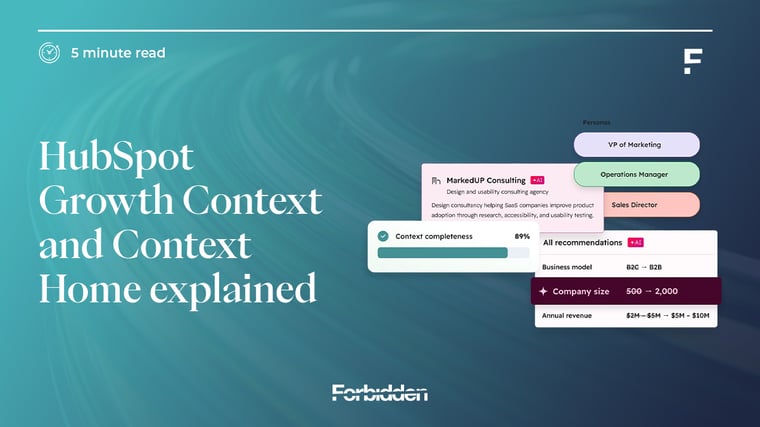
HubSpot’s answer is Growth Context: the information and understanding that turns raw customer data into something AI can use to support real work. Context Home gives HubSpot users a central place to manage much of that understanding.
This is an important change in direction. HubSpot is not simply adding more AI features. It is building a shared context layer intended to make AI more relevant across marketing, sales and service.
For HubSpot users, the opportunity is significant. So is the responsibility to give the platform accurate, well-governed information.
What does HubSpot mean by Growth Context?
HubSpot describes the distinction clearly: data records what happened; context helps explain why.
A CRM may show that a prospect visited a pricing page, attended a meeting and moved into a new deal stage. Growth Context adds the information needed to interpret those events: what the company sells, which customers are a good fit, how the sales process works, what each pipeline stage means, how the brand communicates and what has happened across the wider customer relationship.
In practice, HubSpot’s Growth Context brings together several types of information:
- Customer context, including CRM records, interactions, emails, calls, notes, tickets and buying signals.
- Business context, such as company identity, locations, size, market, technology and products or services.
- Audience context, including ideal customer profiles and personas.
- Team and process context, such as user roles, pipeline definitions, ways of working and communication preferences.
- Brand context, including voice, tone and brand guidelines.
- Situational context, such as the page a user is viewing or the record and task they are working on.
- Specialist knowledge, supplied through files and knowledge vaults for a particular project or AI agent.
The important point is that this context can be reused. Instead of briefing every AI tool from scratch, HubSpot can apply shared business context across multiple AI-assisted tasks.
What is Context Home?
Context Home is the management layer for this information inside HubSpot. In HubSpot’s current documentation, users access it through the Context area in Agent Hub.
It separates context into five practical areas:
1. Business
This is where teams can define the organisation itself: its identity, classification, location, scale, business profile, market, ecosystem, technology stack, products and services. It also links to HubSpot’s brand kit for voice, tone and brand guidelines.
2. Customers
Teams can define ideal customer profiles and personas. This gives HubSpot more than a list of contacts; it provides an explicit view of the organisations and people the business is trying to reach.
3. Team and processes
This includes user profile information and email personalities that control preferred tone, voice and style for different types of communication.
4. Custom context
Businesses can add information that does not fit neatly into the standard structure, either as free-form text or uploaded files. Visibility can be controlled so that the right context is available in the right places.
5. Knowledge vaults
Knowledge vaults are different from the shared foundational context. They are curated collections of information applied to particular projects or agents. That makes them useful when an AI tool needs specialist knowledge without treating it as a universal truth for the whole business.
This structure matters because it begins to make AI context manageable. Rather than leaving important knowledge scattered across prompts, documents and individual users’ heads, Context Home creates a more deliberate source of truth.
What will Growth Context enable for HubSpot users?
The benefit is not one isolated capability. It is the possibility of more relevant assistance throughout the customer journey.
More useful marketing support
Breeze Assistant can use customer, brand and performance context when helping teams define audiences, plan campaigns and create content. HubSpot’s AEO tools can also use CRM information to suggest the questions a company’s customers may ask in answer engines, rather than relying entirely on generic keyword assumptions.
The practical opportunity is faster campaign planning and content that is better aligned with the intended audience and brand. That does not remove the need for marketing judgement. It gives that judgement a stronger starting point.
Better-informed prospecting
HubSpot’s Prospecting Agent can combine CRM history, target personas and external buying signals to identify and research potential accounts. When the underlying context is accurate, outreach can reflect the prospect, the business’s offer and the reason an account may be in market.
For sales teams, that could reduce time spent researching poor-fit accounts and drafting first-touch messages. But the quality of the result will depend heavily on the quality of the ICP, persona and product information provided.
Less sales administration
Smart Deal Progression uses meeting transcripts alongside emails, notes, deal history, pipeline definitions and forecasting logic. It can suggest CRM updates, draft follow-ups and identify next steps after a call.
This is a useful example of why context matters. A transcript alone can show what was said. The wider account history and the company’s own sales process help determine what should happen next.
More relevant customer service
Customer Agent can draw on knowledge content, CRM data and conversation history to answer questions. HubSpot has also added more control over tone, channels, working hours, rollout and escalation.
The potential is not simply to automate more tickets. It is to resolve suitable enquiries faster while preserving a route to a human when the issue is sensitive, complex or commercially important.
A common foundation for custom agents
Shared context should also make custom AI agents more consistent. Teams can use broad business context where it applies, then add a focused knowledge vault for the agent’s particular job.
That reduces repeated setup and helps avoid a common problem: several AI tools representing the same organisation in different ways.
What changes for HubSpot administrators and leadership teams?
Context Home makes AI easier to configure, but it does not make governance optional. It creates a new operational responsibility.
Someone must decide:
- which information is authoritative;
- who owns each part of the context;
- who is allowed to change it;
- which information should apply across the business;
- which information belongs in a restricted or use-case-specific knowledge vault;
- how often the information should be reviewed;
- how inaccurate or outdated context will be identified.
HubSpot currently requires Super Admin or Partner Admin permissions for most context changes, with limited exceptions. That is a sensible control, but permission alone does not provide ownership. A technically authorised administrator may not be the right person to define the company’s target market, commercial proposition or sales methodology.
Good governance will require input from marketing, sales, service, operations and leadership. The platform team can manage the structure, but the business must own the truth inside it.
The quality of your AI will expose the quality of your operating model
Growth Context does not fix weak foundations. It makes them more visible.
If lifecycle stages are unclear, products are described inconsistently, ICPs are too broad, processes vary by individual and CRM data cannot be trusted, AI will inherit those problems. It may even apply them faster and at greater scale.
Before enabling AI across every team, HubSpot users should ask:
- Is our CRM data reliable? Check duplication, missing fields, inconsistent property use and incomplete interaction history.
- Are our processes explicit? Define lifecycle stages, pipeline rules, qualification criteria, handovers and escalation routes.
- Is our commercial positioning clear? Agree who the business serves, what it offers and why customers choose it.
- Is ownership clear? Assign accountable owners for business, customer, brand and process context.
- Are the controls proportionate? Review permissions, visibility, data-sharing settings and the material supplied to agents.
- Can we measure the outcome? Establish baselines before rolling out a use case.
This is why AI readiness is not primarily a prompt-writing exercise. It is a question of data, process, governance and commercial clarity.
A practical way to approach Context Home
The strongest approach is to start with a business constraint, not the technology.
If salespeople spend too much time on administration, for example, assess whether Smart Deal Progression could reduce manual CRM updates and follow-up work. Then identify the context it needs: complete interaction history, agreed deal stages, usable pipeline definitions and clear forecasting rules.
If customer service is struggling with repetitive enquiries, start with ticket volume, resolution time and escalation quality. Review the knowledge available to Customer Agent, define which enquiries it should handle and establish when a human must take over.
For each use case:
- Define the problem and the outcome that matters.
- Identify the data and context required.
- Improve the underlying process where necessary.
- Configure access, ownership and safeguards.
- Test with a controlled group or channel.
- Measure quality, time saved, adoption and commercial impact.
- Improve the context and process based on what the results show.
That turns Context Home from a settings exercise into part of a continuous improvement cycle.
What should businesses measure?
The right measures will depend on the use case, but useful examples include:
- time spent researching accounts or preparing for meetings;
- time between a sales call and completed follow-up;
- proportion of suggested CRM updates accepted or corrected;
- data completeness and accuracy;
- campaign production time and content revision rate;
- service resolution time, automated resolution rate and escalation quality;
- user adoption and frequency of meaningful AI use;
- conversion, pipeline progression or retention where a credible link can be established.
Avoid treating the volume of AI-generated content or the number of activated features as success. The purpose is to improve how the business operates, not to maximise AI activity.
The bigger picture: HubSpot is becoming a system that understands the business
Growth Context strengthens HubSpot’s position as more than a database or collection of tools. The platform is moving towards a model in which CRM data, business knowledge, processes and AI work together.
For organisations already using HubSpot across marketing, sales and service, that could create a meaningful advantage. The more complete the customer relationship and the clearer the operating context, the more useful HubSpot’s AI can become at the point of work.
But the advantage is not automatic. Context Home will only be as good as the thinking, information and governance behind it.
The immediate task for HubSpot users is therefore not to switch everything on. It is to decide where better context could remove a genuine constraint, build the foundations that use case needs and measure whether the change improves performance.
Done well, Growth Context can help teams spend less time briefing generic tools, searching for information and completing avoidable administration. More importantly, it can help HubSpot support better decisions and more consistent execution across the customer journey.
That is the real opportunity: not AI for its own sake, but a business that becomes easier to understand, operate and improve.
How Forbidden can help
Forbidden helps businesses identify where AI, automation and better use of HubSpot can create genuine commercial or operational value. We assess the processes, data, governance and connected technology behind the opportunity, then implement and optimise the right solution.
If you want to understand where Growth Context could make the greatest difference in your business—and what needs to be in place first—speak to our team.

Related posts